
research/adversary-mindset/index.mdx
The Adversary Mindset: How Red Teamers Think Under Pressure
A human look at the mental operating system behind red teamers and penetration testers — persistence, composure, creativity, and discipline when the path is unclear.

$ cat ./research/adversary-mindset/index.mdx --section summaryLoaded sanitized MDX. Rendering public, published research content only.
Summary
The adversary mindset is often misunderstood. From the outside, people sometimes reduce it to tools, speed, payloads, or the ability to find a clever weakness before anyone else does. That version is too small. It misses the part of offensive security that is harder to show in a screenshot: the patience, composure, judgment, and structured curiosity required to keep thinking clearly when the path is unclear.
Red teaming and penetration testing are not clean linear exercises. Real assessments involve uncertainty, imperfect information, time pressure, incomplete assumptions, emotional friction, and moments where nothing works the way you expected. The difference between a capable operator and someone simply running tools is not that the capable operator never gets stuck. They get stuck too. The difference is what they do next.
This article is about professional thinking, discipline, ethics, and assessment habits. It does not include exploitation steps, payloads, evasion guidance, or real-world attack procedures.
What the adversary mindset really means
The adversary mindset is the habit of looking at a system through relationships, assumptions, trust boundaries, and unintended paths. It is not about being reckless or aggressive. It is not about forcing a technique until something breaks. It is about asking better questions when the obvious answer is not enough.
A red teamer looks at an environment and asks what is trusted, what is exposed, what has been normalized, what was added quickly, and what might behave differently at the edge of the design. A penetration tester does the same thing at a smaller or more focused scope. The work changes, but the mental pattern is similar: understand the system, map the assumptions, test the boundaries, and let evidence refine the path.
That mindset is technical, but it is also behavioral. It requires humility because your first theory may be wrong. It requires patience because meaningful findings are rarely handed to you fully formed. It requires discipline because curiosity without structure turns into noise. Most importantly, it requires calmness under pressure because pressure can make smart people careless.
Technical skill is not enough
Technical skill matters. A strong operator needs depth across applications, identity, networks, cloud, endpoints, source code, logging, reporting, and the small implementation details that turn theory into evidence. But technical skill alone is not the whole craft.
Two people can know the same tool. Two people can understand the same vulnerability class. Two people can read the same public research. One stops when the first route fails. The other pauses, writes down what failed, separates facts from assumptions, and looks for the next meaningful angle.
That difference is not just knowledge. It is operating discipline.
Good offensive security work often depends on seeing how small observations connect. A minor inconsistency may reveal a process gap. A naming pattern may point to an overlooked asset. A blocked route may still expose a useful control boundary. A low-impact issue may become meaningful only when combined with another observation later. Strong operators do not treat these details as random trivia. They keep them organized until the environment teaches them what matters.
Thinking in branches, pivots, and trust boundaries
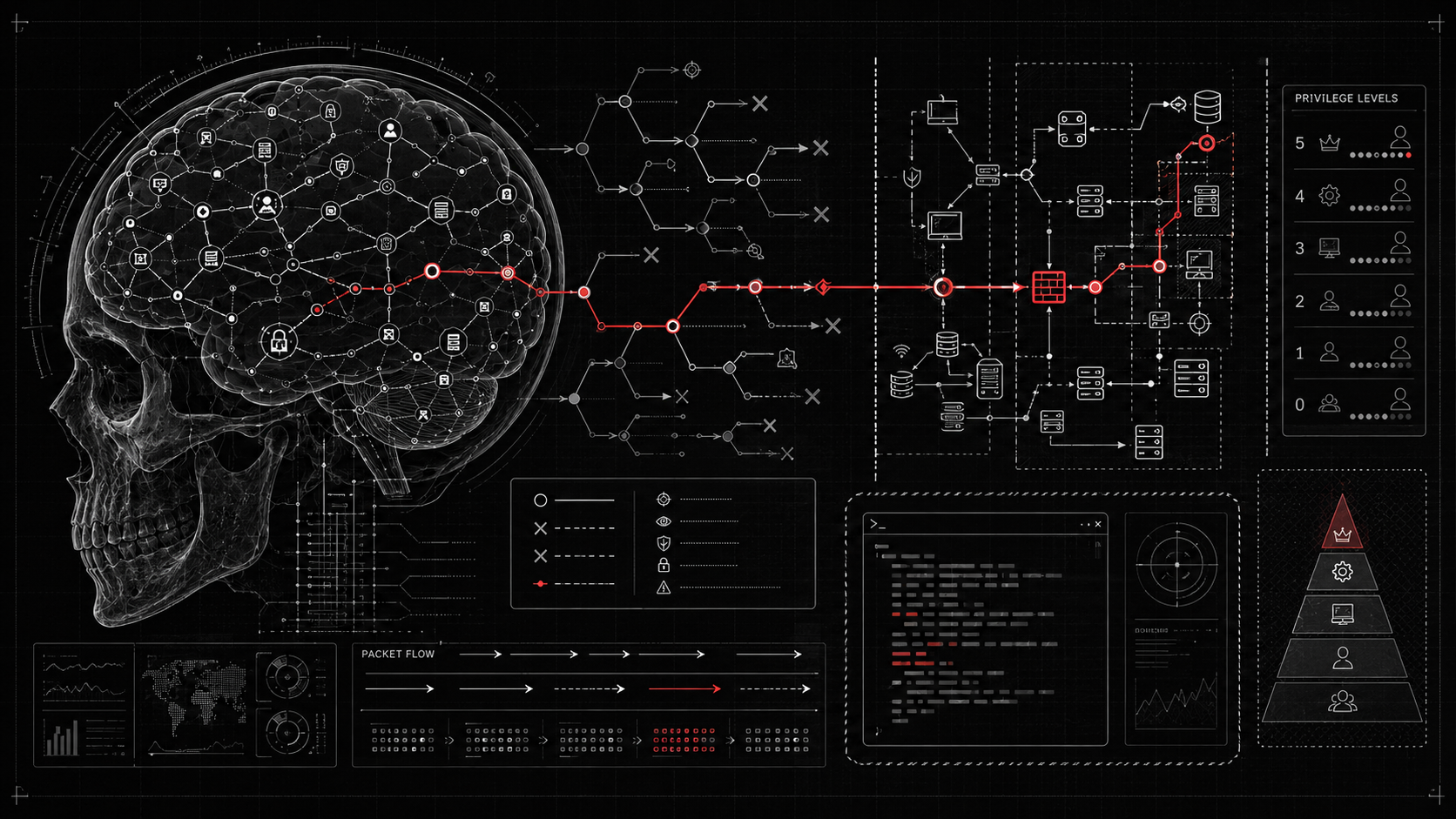
Beginners often imagine assessments as a straight path: find issue, prove issue, write issue. Real work is usually more like a branching graph. Each decision opens or closes possibilities. Each failed route updates the map. Each new piece of evidence changes the weight of the next move.
This is why operators think in branches. If the direct route is closed, they consider adjacent routes. If a technical control works as intended, they ask whether the surrounding process is weaker. If a system rejects one assumption, they ask which assumption survived. This does not mean wandering randomly. It means holding multiple hypotheses while staying anchored to evidence.
Trust boundaries are especially important. Security failures often appear where one system, user, service, process, or integration trusts another too much. The mindset is not simply, "Can I break this?" A better question is, "What does this system believe, and what happens if that belief is incomplete?"
That kind of thinking makes the work more precise. It turns curiosity into investigation instead of noise.
Failure is signal, not defeat
Failure is part of offensive security. Promising leads die. Assumptions collapse. A path that looked useful becomes irrelevant. A control behaves correctly. A theory turns out to be wrong. None of that means the work failed.
Failure becomes valuable when it is treated as signal.
If something does not work, the question is not only "What now?" It is also "What did this teach me?" Maybe the control is stronger than expected. Maybe the environment behaves differently across roles. Maybe the issue is not where you wanted it to be. Maybe the failed attempt revealed a useful boundary, dependency, or monitoring behavior.
The strongest operators are not emotionally attached to a single path. They respect the evidence enough to change direction. That sounds simple, but under pressure it is difficult. Ego wants the first theory to be right. Fatigue wants the next attempt to be easy. Frustration wants movement even when movement is not progress.
Signal requires attention. If you do not observe failure carefully, you lose information that could have shaped the next decision.
Pressure changes how people think
Pressure changes behavior. Deadlines, client expectations, rules of engagement, limited access, reporting windows, and internal expectations can all compress judgment. Under pressure, people often move faster than their thinking can support. They skip notes. They overtrust memory. They repeat actions that feel productive but do not change the situation.
Calm is not a personality trait reserved for certain people. In professional testing, calm is a practice. It is the ability to slow down enough to regain structure without becoming passive.
When pressure rises, useful questions become simple:
- What do I know?
- What am I assuming?
- What failed?
- What worked?
- What changed?
- What am I ignoring because I want a faster answer?
These questions protect the quality of the work. They prevent activity from replacing progress. They also help keep reporting honest. A clear assessment is not built from confidence alone. It is built from evidence, context, and restraint.
The emotional side of offensive security
Offensive security has an emotional layer that does not always get discussed. There is frustration when a route dies. There is doubt when an environment refuses to open up. There is fatigue when everything looks interesting but nothing becomes impact. There is ego when a theory feels elegant and you want it to be true.
Ignoring those emotions does not make them disappear. A better approach is to notice them without letting them drive the assessment.
A professional operator can say, "This path is not producing evidence," and move on. They can ask for another perspective without treating it as weakness. They can take a break before tiredness turns into careless work. They can write down uncertainty instead of hiding it behind confident language.
That steadiness matters. It protects the client, the report, and the operator's own judgment.
Creativity is not chaos
Creativity is necessary in red teaming and penetration testing, but useful creativity is grounded. It is not random repetition or dramatic guessing. It is structured imagination guided by what the environment has already shown.
Creative operators ask what else could be true. They look for overlooked edges, unusual relationships, quiet process gaps, and design assumptions that no longer match reality. But they do not abandon evidence. A creative idea must eventually become a testable hypothesis, and a testable hypothesis must eventually become documented proof or be discarded.
That balance is the heart of good offensive work. Too much structure without imagination becomes checklist testing. Too much imagination without structure becomes noise. The adversary mindset lives between those extremes.
The discipline to keep going
Persistence is not doing the same thing repeatedly and hoping frustration turns into results. Disciplined persistence means adapting.
You try. You observe. You learn. You adjust. Then you try again from a better position.
This is especially important for junior pentesters. Early in the craft, it is easy to confuse effort with progress. Long hours do not automatically mean better thinking. More attempts do not automatically mean better coverage. The quality of persistence depends on whether each attempt is informed by something.
When stuck, it helps to ask:
- Do I need more information?
- Do I need to validate an assumption?
- Do I need to zoom out?
- Do I need to change angle?
- Do I need to stop forcing this path?
- Do I need rest before my judgment degrades?
These questions turn persistence into a controlled process.
Habits that build the mindset
The adversary mindset can be trained. It is built through repeated habits, not slogans.
Write hypotheses before chasing them. This forces clarity and makes it easier to notice when reality disagrees.
Separate facts from assumptions. A fact is something observed. An assumption is something believed. Mixing them creates weak conclusions.
Document dead ends. Dead ends help explain coverage and can reveal patterns later.
Review your own work after pressure has passed. Ask where emotion, speed, or ego influenced the assessment.
Practice explaining findings clearly. If you cannot explain the risk in plain language, you may not understand it well enough yet.
Read defensive perspectives. Understanding how incidents are investigated, how telemetry is reviewed, and how controls are validated makes offensive testing more responsible and more realistic.
Stay scoped. Authorization is not a formality. It is the line that makes the work professional.
Practical takeaways
The adversary mindset is not about pretending pressure does not exist. It is about building a process strong enough to survive pressure.
Stay calm when the first path fails. Treat failure as signal. Think in branches. Respect trust boundaries. Let evidence lead creativity. Write down assumptions. Keep your ego out of the report. Pause when fatigue starts shaping decisions. Stay ethical, scoped, and professional.
For junior pentesters, the most useful advice is simple: learn to stay in the problem without becoming consumed by it. Curiosity matters, but so does restraint. Persistence matters, but so does direction. Confidence matters, but only when it is earned by evidence.
The ethical edge
The adversary mindset is powerful because it teaches you to see systems differently. That power needs boundaries.
Professional red teamers and penetration testers operate with permission, scope, rules, and accountability. The goal is not to be dangerous for its own sake. The goal is to help organizations understand risk before a real attacker can exploit it. That means protecting client trust, handling evidence carefully, avoiding unnecessary harm, and reporting clearly.
Ethics are not separate from capability. They are part of it.
Final thoughts
The real edge in offensive security is not just knowing more tools or moving faster than everyone else. It is the ability to think clearly when the environment is uncertain, when the clock is moving, when the first idea fails, and when frustration starts to distort judgment.
That is the adversary mindset.
It is patient without being passive. Creative without being chaotic. Persistent without being reckless. Technical without forgetting the human side of the work.
And in the moments where the path is unclear, that mindset is often what keeps the work moving.
Affected technology
Disclosure timeline
Related posts
No research found
Try a different search or filter set.